Wednesday, April 5, 2023
Fit to Die: A Thriller by Daniel Kalla ~ A Book Review
Tuesday, April 4, 2023
A Review Of Geoff Hamiltons Cottage Gardens Book
Here is my review of Geoff Hamilton's book "Cottage Gardens". Geoff Hamilton was my inspiration and education where gardening was concerned and I have learned an incredible amount from his books, TV series and his gardens.
In this book at approximately 250 pages of text and photographs, he specifically concentrates on Cottage gardens. This happens to be my most loved style of gardening so I was always going to buy and treasure this book.
In fact, I am rapidly buying up every Geoff Hamilton book I can as I am concerned his books will start to get more difficult to find. He sadly died 4th August 1996 at the age of 59 and of course now there are many other good gardeners on the scene and many other books.
However, for me, Geoff's enthusiasm, knowledge and style of gardening will never go out of fashion. I feel in tune with his methods. His writing seems to speak directly to me as if he were teaching me and I need his ongoing guidance to improve my own gardening.
I have written about my admiration and joy when visiting Geoff Hamiltons Barnsdale Gardens near Oakham in UK in A Personal Review Of The Inspirational Gardener Geoff Hamilton
If you are looking for a down to earth, enthusiastic, knowledgeable and practical gardening guide to "Cottage Gardens" please take a look at this book.
The photos included here are all of my own photographs taken either at Barnsdale Gardens or in my own garden at home.
Section One History Of The Cottage Garden
Section one covers a fascinating history of the cottage garden and the people who tended them.
Cottage gardens have been in existence in some form since the Middle Ages in UK and the premise for all cottage gardens is that they are there to be used. These gardens were used primarily for food, herbs and some medicinal purposes, plus some flowers to lift the spirits.
Geoff takes us through the Cottage garden in the UK and how it its use changes and evolves through the Middle Ages ( 500- 1400) to the enlightened era of the Elizabethan age (1533- 1603) onto the Victorians and beyond and into the twentieth century.
It includes discussions of gardens and the role of people who were the labouring classes, the craftspeople and the wealthier people.
It discusses the role of medieval medicine and primitive gardening techniques and how over time improvement in living conditions meant more vegetables and fruits were consumed and how gardening developed.
He highlights certain influential gardeners over time such as Capability Brown, Humprey Repton and William Robinson.
The role of topiary and model villages is discussed along with the effect of social divisions, revolts, reforms and philanthropic movements. He covers the role of Allotments and the evolution of the Cottage Garden into the more modern age.
Section Two Creating A Cottage Garden
Section two instructs us on how to create a Cottage Garden and covers two different styles.
The first is very much a working garden to feed us and be as productive as possible.
This is the affordable Artisans garden, which is built specifically with low cost and reclaimed or second hand materials in mind. More is handmade and plants grown and raised from young.
This style of garden is much more like the original cottage gardens built and tended by working people, would have looked.
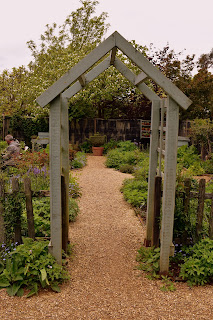
| Entrance to Artisan Cottage Garden Barnsdale. Photo by Raintree Annie |
The second garden is more stylized, an idea rather than the reality of the rustic garden, with far more comforts and romance.
Vegetables would be grown, but were not essential to the gardener for food for the family.
This is the more expensive Gentleman's garden, where cost is not really an issue. It is altogether more elaborate and uses more costly materials.
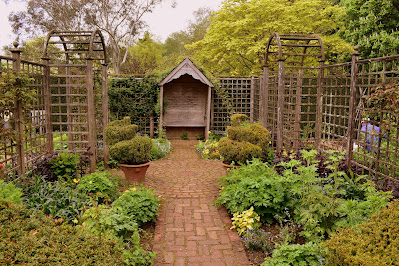
| Gentlemans Cottage Garden Barnsdale UK. Photo by Raintree Annie |
I had the pleasure of seeing both these gardens in Barnsdale gardens designed and built by Geoff Hamilton, they have stood the test of time and look fantastic.
Interesting Geoff said that he enjoyed making the more affordable Artisan garden more than the more expensive Gentleman's garden. When you understand more of the man and gardener he was this is not surprising.
He believed there is creative pleasure in making items, raising plants, developing a personal garden and saving money.
He understood that people can and do buy some ready-made items and grown plants for the garden, but his hope was that gardeners would take ideas from both types of gardens and using our creativity, make them our own.
So we learn about building these two gardens from principles to the layout. Which important aspects to include, how to consider designing it, what sort of boundaries to consider and what materials to use.
He includes information on arbours and benches, herb tables and love seats, paving, compost bins, containers and cold frames. He details what to consider, how to build and design and gives a very comprehensive overview of both gardens. The photographs and pictures are lovely and bring it all to life.
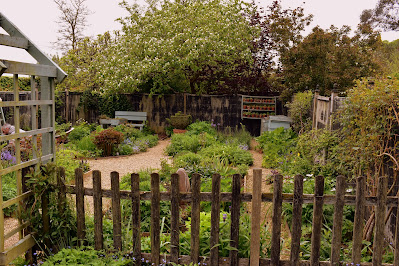
| Artisan Cottage Garden Barnsdale. Photo By Raintree Annie |
Plants In The Cottage Garden
Then the book goes into more detail about the plants to use at the back, middle and front of the border to provide those layers of use and interest in the garden.
This section includes propagation techniques so we can make more plants for free! This is always a very useful and easy skill to learn for anyone who has a large garden to a window box.
Geoff's love of plants and trees comes through and he details how to choose and look after trees, climbers, ramblers, border plants, shrubs, herbaceous plants, bulbs, annuals, biannuals and topiary. It details a wealth of plants that we can include according to our situation and needs.
Section Three A Cottage Economy
Section Three covers "A Cottage Economy" and teaches us how to grow and tend a wide variety of vegetables, herbs, tree fruit and soft fruit.
He includes cultivation methods and how to grow vegetables in borders. It is a very useful, practical and interesting guide to growing and tending these plants.
The way Geoff Hamilton approaches the information, it all seems totally achievable and straightforward to learn.
Cottage Garden Plants Through History.
Finally the book discusses Cottage Garden Plants Through History where he gives a snapshot of plants that would have been grown through the ages. Although a short section this is quite fascinating to learn what was grown in different eras in history.
I bought this book in the UK as a hardback copy but it is available via Amazon in hardback and paperback and I imagine it is the same book.
If you have the smallest interest in gardening or even garden history in terms of cottage gardens and the way people lived with them and how they evolved, this book is very interesting and a worthwhile read.
If you love gardening and want to learn more from a true master I do not hesitate to recommend Geoff Hamilton's Cottage Gardens Book either for yourself or as a beautiful gift.
Geoff Hamilton died many years ago now but even today, or perhaps more so today, many people grow vegetables and fruit in gardens or allotments to supplement the weekly shop.
With shortages and prices of vegetables, salad and herbs rocketing in the shops, growing food ourselves can make it more accessible and affordable to us.
I wonder if gardening may again become something we need to know how to do and an essential life skill to pass on to the next generation as it used to be. So maybe the story or history of the Cottage Garden is not yet over.
More Gardening Articles
Monday, April 3, 2023
Easter Cactus: Enjoy Early Spring Blooms with this Easy Care Houseplant
I have only just learned that there are beautiful houseplants currently in bloom called Easter (Spring) Cactus. The blooms of this plant can range from white, red, orange, peach, purple, and pink. The one I chose to bring home has delicate, light pink petals with dark pink and light yellow stamens. During this time of year, when forsythia are in bloom and not much else, it is wonderful to have a bright splash of color announcing spring.
Easter (Spring) Cactus
The Rhipsalidopsis is a red-flowered native to southeastern forests of Brazil in altitudes of 1,100 - 4,300 feet. It seems that at some point, the Rhipsalidopsis was crossed with the R.rosea which resulted in the popular Rhipsaldopsis gaertneri which created the variety of flower colors. These colors include pink, orange, purple, white, and orange.
Plant Care
The Easter (Spring) Cactus does well in temperatures of around 77 degrees fahrenheit in the summer and around 45 - 55 degrees fahrenheit in the winter (November to January) to help with bud formation.
From their origin in Brazilian forests, they are plants that do not prefer strong sunlight. They prefer partial sunlight.
Easter (Spring) Cactus does not like over-watering. It is best to allow the soil to dry between waterings then water so that it drains out of the bottom of the planter. It needs loose, nutrient-rich potting mix soil. Soil mixes with coco coir, peat moss, perlite, or orchid bark are preferred.
Easter (Spring) Cactus propagation can be done by removing stem segments in the late spring, allowing the cut surface to dry a bit, and placing the stem in moist soil. Another method of propagation is removing a single leaf from the plant, place the end of the leaf into moist soil, place bags over the plant in order to hold moisture in until the roots begin to sprout.
What I Wanted was a Christmas Cactus but I'm Thrilled with this Easter Cactus
I had the most beautiful, prolifically blooming Christmas Cactus at my previous office. For the past year, including over the holidays, I watched for a Christmas Cactus to replace the one I left behind when I moved. I did not see any at the usual stores where I usually find a large selection of seasonal plants.
This past week I was at a nursery to look for Crape Myrtle trees and there I spotted a large selection of what appeared to be Christmas Cactus. But they were labeled Spring Cactus. I loved them and brought one home without knowing quite what they were.
It seems that the Christmas Cactus, a different species than the Easter Cactus, is called Schlumbergera and is also native to Brazil. There are two cultivar groups called Truncata and Buckleyi. And that is about the extent of my new knowledge of the taxonomy of these plants.
I still hope to find a Christmas Cactus to add to my household plants. Blooms during the dreary, cold winter months add something wonderful to a northern indoor space. In the meantime, I will enjoy the gorgeous pink blossoms of my Easter Cactus while I wait for Mother Nature to allow other plants to show off their flowers.
Sunday, April 2, 2023
Step Up Your Entryway Game: Tips for a Tidy Front Hall Closet
![]() |
Here are some tips on how to organize your front hallway closet effectively:
Start by decluttering: Take everything out of the closet and sort items into four piles: keep, move it to another closet, donate, and toss. Only keep items that you use regularly and are in good condition.
Use hanging space wisely: Invest in good-quality hangers that hold multiple items or heavier coats. For lighter items, consider tiered hangers. Hang coats and jackets in order of season and frequency of use, with the most frequently used items at the front. Or, of course, you can store your winter items in another location for spring, summer, and fall.
Use bins or shelves for storage (whichever works best for your sized closet): Stacking bins or drawer bins are an excellent solution to store hats, gloves, scarves, and other small items. Clear bins are an excellent choice to see what's inside before opening.
Maximize floor space: Use the floor space of the closet for storing shoes and boots. You can use shoe racks or a hanging shoe organizer to keep shoes off the floor.
Utilize door space: Over-the-door organizers are perfect for storing items such as umbrellas, purses, and even some pairs of shoes.
Invest in hooks: Hooks are a great way to keep bags, hats, and other items off the floor and organized.
Label Bins: Use labels on baskets, bins, and shelves to help keep everything organized and easy to find. This will only work if the people in the house make an effort to put things back in the appropriately labeled bin.
Keep seasonal items separate: Store seasonal items, such as winter coats and boots, in a separate closet or in the back of the closet. This will free up space for items that you use more regularly.
Maintain the organization: Once you have organized your front hallway closet, it's essential to maintain it. Make sure to put items back in their designated spots and regularly declutter to prevent the closet from becoming cluttered again.
Use vertical space: If you have high ceilings in your closet, consider using vertical space by installing additional shelves or hanging rods. This will allow you to store more items without taking up extra floor space.
Use slim hangers: Slim hangers are a great way to save space in your closet, as they take up less room than traditional hangers. They also help prevent clothes from slipping off the hanger.
Store accessories together: Keep all your accessories in one designated closet area. Stacking storage bins can keep these items organized and easy to find.
By following these tips and utilizing storage items such as hangers, shelving, baskets, bins, and hooks, you can effectively organize your front hallway closet and make room for coats, hats, seasonal outerwear, boots, and shoes.
Some Suggested Product Ideas For You:
Saturday, April 1, 2023
A Holiday Review of Read a Road Map Day
Take a step back in time and use a paper road map to plan a trip. Read a Road Map Day is celebrated on April 5 each year.
Almost everyone has a GPS these days, even on our cell phones, which gets us to our destinations quickly, in the shortest manner. This works great for finding locations when needed. But is your trip about a destination, or would you like to go on a journey?
Road maps are more than just directions to a destination. They help us plot a fun journey and allows us to have a pleasant experience. By getting off today's superhighways, we can identify and discover small and interesting towns or historic sites.
How to Celebrate Read a Road Map Day
On April 5th, the designated day for 'Read a Road Map Day', get out your Rand McNally Road Atlas, your state map or a map of your city and take a Day Trip or a weekend trip to someplace you haven't been.
Or just use a spinner and let it find you a direction to take, get in your car and begin driving. Your map will show you what is ahead in the direction you are going. Stop in one of the next small towns you go through and see what you can find. Perhaps a local diner that has been there forever will be the perfect place to stop for lunch. Maybe a statue in the town square will give you a bit of history of the place.
There are many interesting sites (and sights to see) that can be found on road maps. City maps often show the location of art museums, historic sites, and parks & lakes in your own town. Go visit one or more on a weekend. Take the family and expand your children's horizons. Depending on the size of your town, I'll bet there are many places you have never visited. And a state map has a wealth of information for going on a sightseeing road trip. What does your state have to offer? Have you ever visited your State Capital, for instance?
Summary
So use April 5 – the date of the holiday Read a Road Map Day – and go get a city, state or national map to decide on an interesting way to have an adventure or simply a fun Daycation.
Related Link:
+All Images courtesy of Pixabay.com
*Read a Road Map Day review written by Wednesday Elf
>
The Review This Reviews Contributors
Sylvestermouse
Dawn Rae B
MbgPhoto
Brite-Ideas
Wednesday Elf
Olivia Morris
Treasures by Brenda
The Savvy Age
Margaret Schindel
Raintree Annie
Lou16
Sam MonacoTracey Boyer
Cheryl Paton
Renaissance Woman
BarbRad
Bev Owens
BuckHawk
Decorating for Events
Heather426
Coletta Teske
MissMerFaery
Mickie_G
Review This Reviews is Dedicated to the Memory of Our Beloved Friend and Fellow Contributor
We may be apart, but
You Are Not Forgotten